Neuroscience of Motivation, Action, and Desire Laboratory, Department of Psychiatry & Psychotherapy, University of Bonn & Tübingen
Vagus Nerve Stimulation: New Approaches to Treating Anxiety and Depression
Non-Invasive Vagus Nerve Stimulation for Modulating Approach and Avoidance Behaviors in Depression and Anxiety Disorders (BON008)
Status: We are recruiting and look forward to hearing from you!
Location: Online + Bonn
Key Points About the Study at a Glance
Vagus nerve: The vagus nerve connects the body and brain and influences how we experience stress, emotions, and motivation. Through targeted stimulation, we are researching its effect on behavior related to approach and avoidance in Virtual Reality.
Participation: We are looking for healthy adults and individuals with symptoms of anxiety and/or depression between the ages of 18 and 40.
Compensation: You will receive €24 plus winnings from the task for participating in the online study. This payment will be made after you have completed the online task, online survey, and a subsequent telephone screening (approx. 30 minutes). If you also participate in the on-site appointments, you will receive an additional €126, plus a bonus of up to €30 for completing tasks in the laboratory.
Contact: If you are interested in participating or have any further questions, please contact us using the contact form. We will get back to you as soon as possible.
Your Project Team
Project lead: Dr. Anne KühnelPhD Student: Sarah A. Merklein
Data Protection: The data you provide in the form will be processed by us exclusively for the purpose of responding to or implementing your request, contacting you, and providing you with direct access to the game. For processing, we refer to Art. 6 (1) (a) DSGVO, unless another legal basis applies. Your data will not be passed on to third parties. You can revoke your consent at any time with effect for the future. In the event of revocation, your data will be deleted immediately. Otherwise, your data will be deleted once we have processed your request or the purpose of storage no longer applies.
Summary
Depression and anxiety disorders are among the most common mental illnesses. Conventional treatments such as psychotherapy or medication often have limited effectiveness, especially in cases of severe symptoms or comorbid conditions.
A common factor in many mental illnesses is the altered perception of bodily signals (interoception), such as heartbeat, hunger, or tension. These signals influence how we assess situations and make decisions, for example, whether to approach or avoid something. The vagus nerve, which connects the body and brain, plays an important role in this process. To date, this connection has barely been used therapeutically.
Our project investigates whether the balance between approach and avoidance behavior differs in individuals with anhedonia (reduced ability to experience pleasure) and/or anxiety symptoms, and whether this balance can be altered by changing the body’s own signals. To do this, we use non-invasive vagus nerve stimulation (tVNS) and manipulate physical states, such as hunger.
At the beginning, we conduct an online study in which we assess the learning and decision-making behavior, mood, and motivation of the participants. We then invite selected individuals to participate in further examinations. These include interviews, an MRI scan with blood draw, and virtual reality (VR) tasks. In doing so, we examine how behavior changes in different states, such as hunger or satiety, and how non-invasive stimulation of the vagus nerve influences this behavior. In the VR tasks, participants may move freely and decide for themselves whether they would like to pursue rewards or avoid threats. During the tasks, we gather both behavioral data and physiological responses (e.g., heart rate).
The study aims to provide fundamental insights into whether noninvasive vagus nerve stimulation can modulate approach-avoidance behavior associated with symptoms of anxiety and anhedonia.
Feel free to learn more about our other studies investigating tVNS (both in Bonn):
You will receive €24 plus winnings from the task for participating in the online study. This payment will be made after you have completed the online task, online questionnaires and a telephone screening (approx. 30 minutes) to determine whether you are suitable for further parts of the study.
If you also participate in the on-site appointments, you will receive an additional €126, plus a bonus of up to €30 for completing tasks in the laboratory.
How many appointments are there in the study?
The study consists of an online study (including a short telephone screening) and optional on-site appointments.
Online part: approx. 90 minutes spread over 10 days + 30-minute telephone interview
On-site part: 3-4 laboratory appointments of approx.2-3.5 hours each
Who can participate?
We are looking for healthy adults and individuals with symptoms of anxiety and/or depression aged 18 to 40. Everything else will be discussed with you during the telephone interview, which also serves to assess your suitability for on-site participation after the online part.
How does the online study work?
You will receive access to a portal where you will play a game for approximately 10 minutes each day for 10 days and then fill out an online questionnaire. Once the questionnaire has been completed, we will schedule a telephone interview with you, after which you will either take part in the laboratory appointments or receive compensation for the online part.
How does the laboratory study work?
You will be invited to four appointments:
1) Standardized interview, which is also used in clinical practice to assess possible symptoms.
2) Blood sample and MRI measurement. In the MRI, you will complete a task in which you make decisions to exert effort (grip strength) for rewards or avoid punishments.
3+4) We will measure your avoidance and approach behavior in virtual reality during non-invasive vagus nerve stimulation (tVNS). You will be asked to collect rewards in an environment with potentially dangerous animals.
The winnings you earn in the tasks will be paid out to you at the end in addition to the expense allowance.
Can I only participate in the online part of the study?
Yes, you can only participate in the online part and not attend any further appointments.
Is there a guarantee that I will be invited to the laboratory appointments after participating online?
No, there is no guarantee that you will be invited to participate in the laboratory appointments. Suitability will be assessed during the telephone interview. If you are not able to participate in our study, we can add you to our contact list should you be interested in other or future studies.
How is the vagus nerve stimulated? Are there side effects?
The vagus nerve is stimulated using a small device attached to the ear. The intensity is calibrated with you. The stimulation is not painful.
In this study, we will non-invasively stimulate your vagus nerve using electrical impulses delivered via an external stimulation device placed on your ear.
The vagus nerve is a cranial nerve that transmits signals from the internal organs to the brain. Part of the vagus nerve runs near the ear and can be specifically stimulated through electrical stimulation. This allows us to investigate the effect of vagus nerve stimulation on behavior. Vagus nerve stimulation is currently used primarily in the treatment of epilepsy and depression. A new generation of devices now enables non-invasive stimulation at the ear. The device is CE-certified by the manufacturer for use in the treatment of depression. Initial clinical studies have also investigated other applications and confirmed the procedure’s tolerability. The stimulation electrode is roughly shaped like a hearing aid and is attached to the ear.
Vagus nerve stimulation at the ear will be felt as a slight tingling or prickling sensation at the corresponding site. However, the intensity of the stimulation depends on individual sensitivity, and we ensure that it never becomes uncomfortable. The device manufacturer lists mild stinging or mild pain at the stimulation site as possible side effects. Stimulation of the vagus nerve can affect the autonomic nervous system and the cardiovascular system, which may lead to various possible side effects, such as headaches, drowsiness, dizziness, numbness, temporary hearing problems, unusual sensations, diarrhea, inner ear infections, and heart rhythm disturbances. No long-term side effects are currently known in physically healthy individuals. We will assess your suitability for vagus nerve stimulation on an individual basis before the study begins and monitor any potential side effects that may occur during your participation in the study in direct consultation with our study physician.
What is magnetic resonance imaging (MRI)?
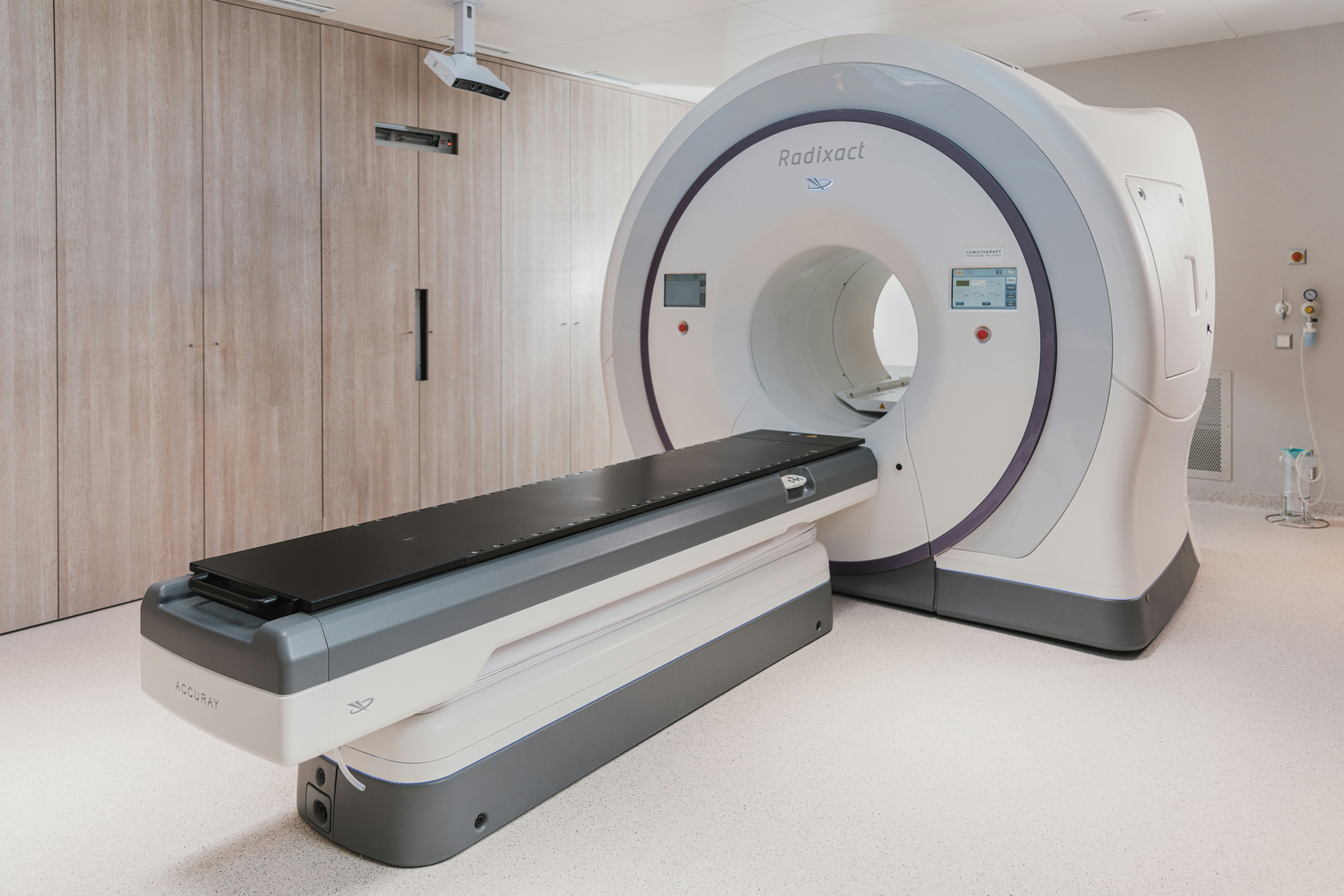
In this study, we also aim to gather information about the processes occurring in the brain, and we will use magnetic resonance imaging (MRI) to do so. MRI is a medical imaging technique used to visualize organs and tissues with the help of magnetic fields and radio waves that are imperceptible to the body. Images of the head are generated from the interaction of magnetic fields and radio waves.
Magnetic Resonance Imaging (Example Image)
What should I keep in mind regarding the study appointments?
Please note that you must come to the study appointments on an empty stomach (MRI). You should come hungry to the virtual reality appointments. We will discuss exactly what you need to bear in mind during the telephone interview.